Nose surgery that keeps your face looking like you
Rhinoplasty with Dr. N. Jithendran — M.S. (Orthopedics), M.Ch (Plastic Surgery), D.N.B. The goal is a nose that looks natural and sits in balance with the rest of your features, planned around your anatomy in a private consultation.
Book your consultation
Send your details and the clinic will contact you to arrange a time.
Signs that rhinoplasty may suit you
Nose reshaping is a highly individual procedure. Dr. Jithendran will assess whether surgery is appropriate for your anatomy and your goals. Some of the common reasons patients ask about rhinoplasty are:
Surgery is generally suitable if:
Rhinoplasty should be a decision you make for yourself — not to meet someone else’s expectations or to match an ideal image. Patients who come to it with emotional maturity and a clear, realistic picture of what they want are usually the most satisfied with the outcome.
A careful assessment before any plan is made
Your consultation is an examination and a conversation, not a sales appointment. Here is what it covers.
Your medical history
Come prepared to discuss any medical conditions, past treatments, previous surgery including repair of nasal injuries, and medications you currently take. Complete information matters here.
Your breathing
Dr. Jithendran will ask whether you have difficulty breathing through your nose, whether allergies cause nasal stuffiness, and whether you use nasal spray regularly.
A painless examination
A routine, painless examination of the internal nasal structures. Your skin quality, the size and shape of your nose, and how it relates to your other features are all studied.
Facial balance
In some cases Dr. Jithendran may suggest chin surgery — making it more or less prominent — to improve overall facial balance. It can be done at the same time as your rhinoplasty.
Risks, discussed openly
Every surgical procedure carries risk. These are best discussed personally with your surgeon and may include haematoma, infection, reactions to anaesthesia, and temporary numbness of the skin.
Cost, after assessment
Fees are discussed once a thorough evaluation is complete and your individual surgical plan is developed. Most insurance will not cover aesthetic reshaping, but often does cover internal surgery to improve breathing.
See a simulation of your result before you commit
Dr. Jithendran is among a small number of plastic surgeons in Bengaluru offering 3D simulation. It is free as part of your consultation, and it turns an abstract decision into something you can actually look at.
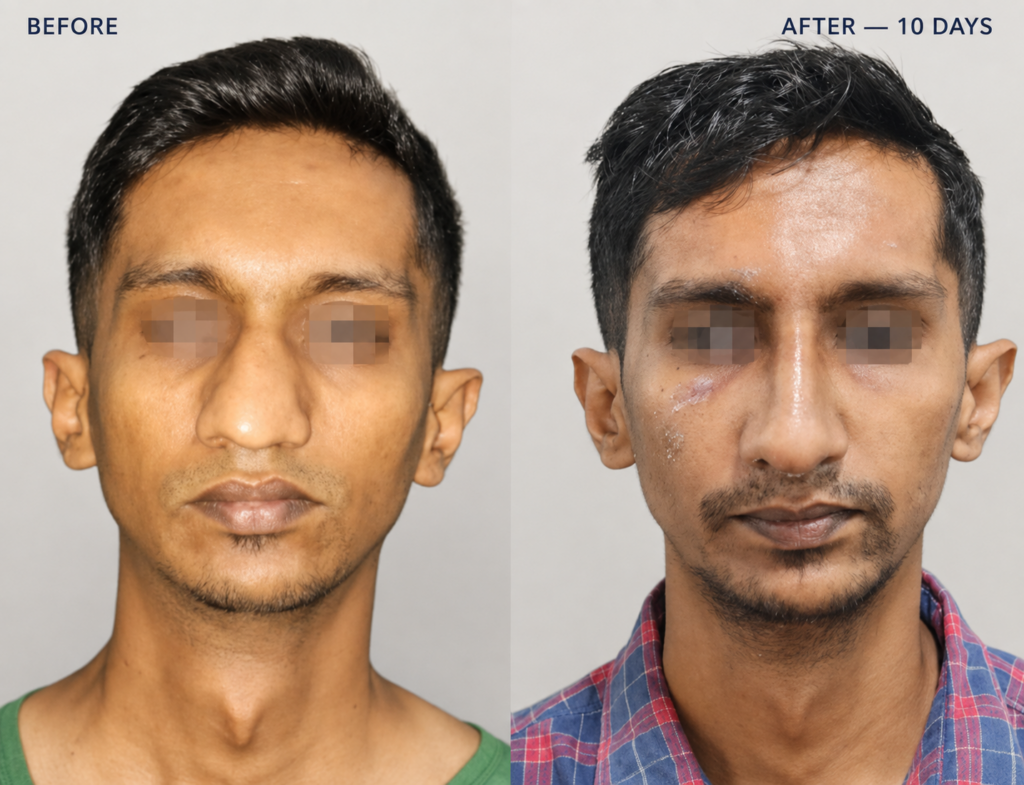
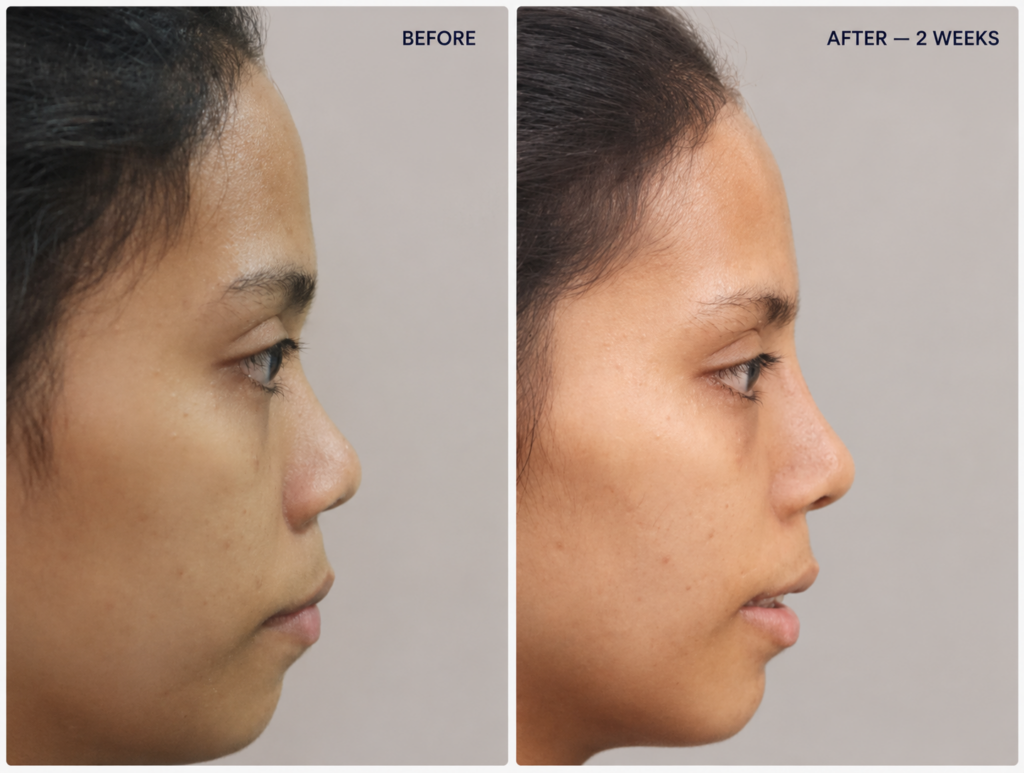
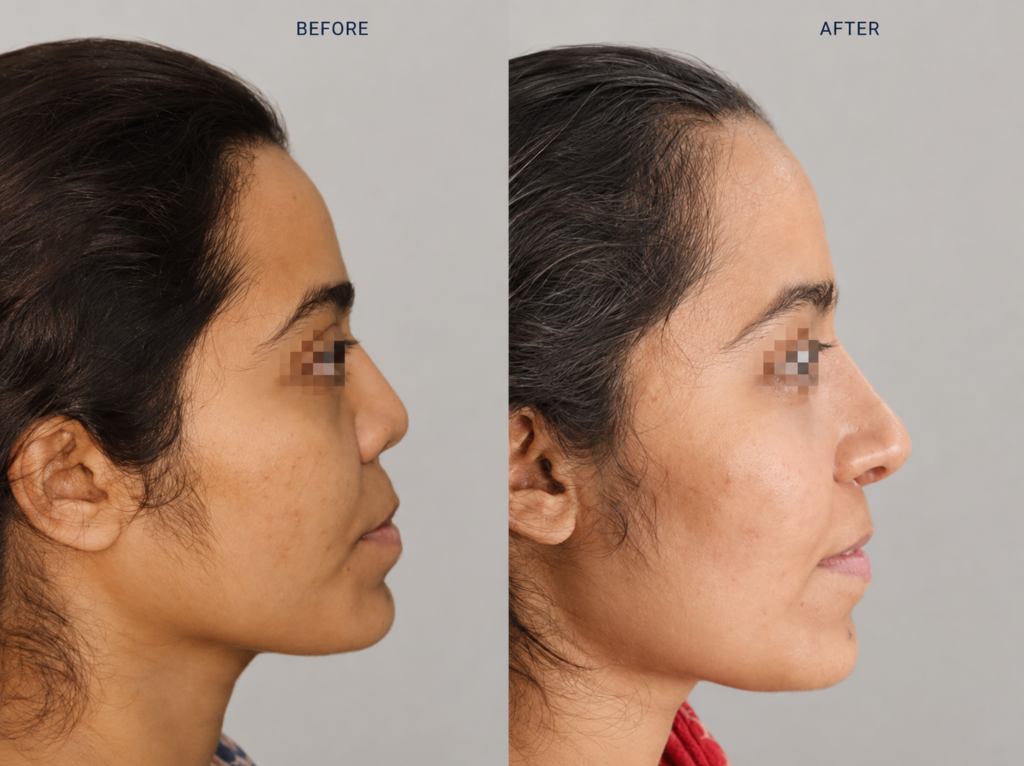
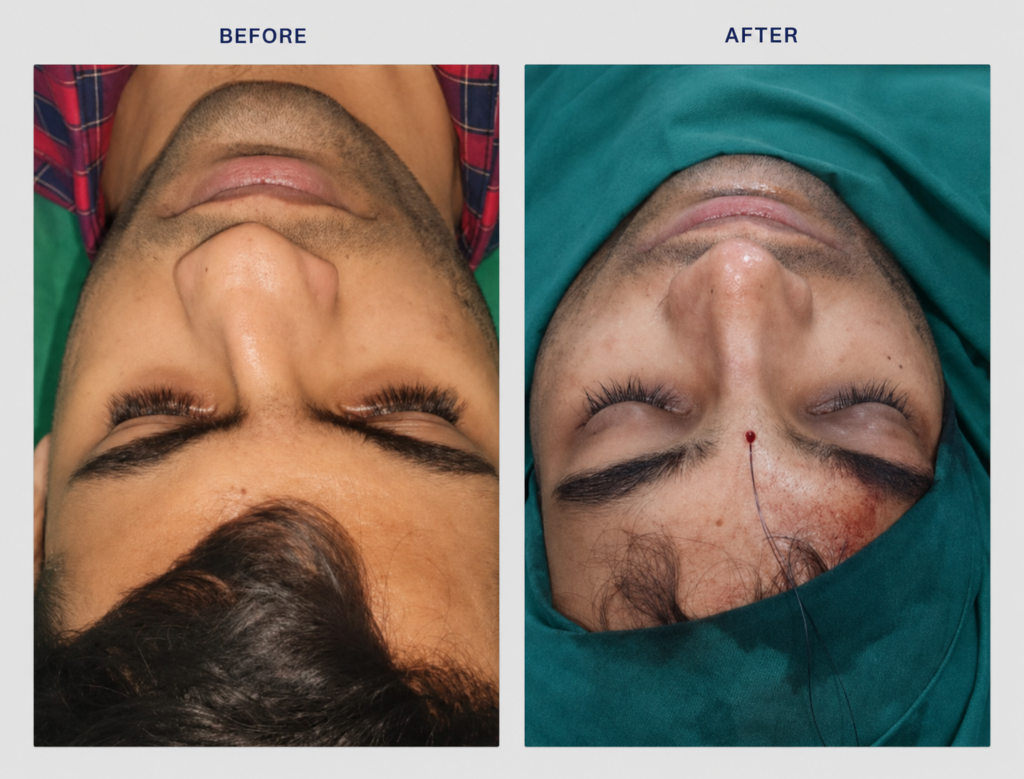
Before and After
Before and After image will show you the image of the patient before surgery and post-surgery for each and every category. This will help you understand the result of each surgery
What the weeks after surgery look like
Healing is gradual. This is the general pattern — your own timeline is confirmed with Dr. Jithendran at your follow-up visits.
A splint may be placed on the bridge
Depending on the surgical technique used, a splint may be placed on the bridge of the nose to hold the tissues in place until they have stabilised.
Avoid straining, bending and lifting
These should be avoided during the early postoperative period while the nose settles.
Many patients return to work
In many cases you may be able to return to work within a week to ten days after surgery.
Most normal activity resumes
Most normal activities, including exercise, can usually be resumed within three weeks.
Glasses may need support
If the bones of your nose were altered, it may be a number of weeks before you can wear glasses without special support such as tape.
Protect your nose from direct sun
Your nose will be sensitive during this period. Be conscientious about using a sunblock to protect the skin.
Final result settles
Expect to wait up to a year to see the final result — though most patients begin enjoying their new look within weeks of surgery.
Dr. N. Jithendran
Aesthetic, Plastic and Reconstructive Surgeon. He holds an M.S. in Orthopedics, an M.Ch in Plastic Surgery and a D.N.B. in Plastic Surgery.
Alongside cosmetic work, his practice covers complex reconstructive surgery — hand and microsurgery, cranial and maxillofacial surgery, burns care, ear reconstruction and cleft lip and palate management. That reconstructive grounding is directly relevant to the nose, which is as much a functional structure as an aesthetic one.
| Degree | Institution | Year |
|---|---|---|
| MBBS | Stanley Medical College, Chennai | 1999 |
| M.S. (Ortho) | G.S.V.M. Medical College, Kanpur | 2003 |
| M.Ch (Plastic Surgery) | Safdarjung Hospital & VMMC, University of Delhi | 2007 |
Why patients choose this practice
Less time under anaesthesia
Shorter operating time means less exposure to anaesthesia, quicker recovery and a lower chance of infection.
Faster return to normal life
The practice works to a recovery protocol designed to get patients back to their routine sooner.
Complex cases welcome
A reconstructive background means comprehensive solutions to complex problems — including revision cases and noses affected by past injury.
What patients say
Reviews published on Dr. Jithendran’s website and Google profile.
Described Dr. Jithendran as talented and hardworking, very concerned about the patient, reachable for any queries and skilled at his job. Reported that the whole process went smoothly and that questions were answered patiently.
Noted that the doctor explained the clinical condition well, including problems that could arise later, and was very responsive — attending to concerns empathetically and with timely advice.
Called him one of the most humble doctors around — someone who puts patients first, is always approachable for questions, and is really good at his work.
Consulting across Bengaluru
Call to confirm which location and time suits you.
Sammprada Onco + Wellness Hospital
Trustwell Hospital
Phoenix Hospital
Apollo Clinic
Rhinoplasty, answered
Am I a good candidate for rhinoplasty?
Nose surgery may be a good option if your facial growth is complete and you are 15 years of age or older, you are physically healthy, you do not smoke, and you have specific but realistic goals for improving your appearance.
It is important to have a clear idea of how you would like your nose to look while also recognising that the procedure has limitations.
How will the surgeon evaluate me?
You will discuss your medical history, including any conditions, treatments, previous surgeries and current medications. You will also be asked about breathing difficulty, allergies causing nasal stuffiness, and regular nasal spray use.
A routine and painless examination of the internal nasal structures follows. Your skin quality, the size and shape of your nose and its relationship to your other facial features are studied carefully.
When will I learn the cost of surgery?
A thorough evaluation must be completed first so that an individual surgical plan can be developed. The fees for your surgery are discussed with you after that.
Most insurance plans will not pay for aesthetic nose reshaping, but they frequently cover surgery performed on the internal structures of the nose to improve breathing problems. This can be discussed at your consultation.
When can I resume normal activities?
Straining, bending and lifting should be avoided in the early postoperative period. In many cases you may return to work within a week to ten days, and most normal activities including exercise can usually be resumed within three weeks.
It will be a few months before you can expose your reshaped nose to direct sunlight, and sunblock is important during that time. If the bones of your nose were altered, it may be several weeks before you can wear glasses without support such as tape.
How long will the results last?
In most instances the results of rhinoplasty are permanent, aside from possible changes associated with normal ageing.
Because healing is gradual, expect to wait up to a year to see the final result — although most patients begin enjoying their new look within weeks of surgery.
What are the risks?
Every surgical procedure has risks, and these are best discussed personally between you and your surgeon or a member of the clinic team.
Potential complications that may be discussed include haematoma — an accumulation of blood under the skin that may require removal — infection, and reactions to anaesthesia. Numbness of the skin after rhinoplasty can occur but is usually temporary. Occasionally, if the outcome needs further improvement, additional surgery may be necessary; this is usually less extensive than the original operation.
Can rhinoplasty also help my breathing?
Breathing is part of the assessment. You will be asked whether you have difficulty breathing through your nose, whether allergies cause stuffiness, and whether you use nasal spray regularly — and surgery on the internal structures of the nose to improve breathing is frequently covered by insurance, unlike aesthetic reshaping.
What happens after surgery — do I keep seeing the surgeon?
Yes. You return to the clinic for follow-up care at prescribed intervals, and your progress is evaluated at each visit. The relationship with your plastic surgeon does not end when you leave the operating room — if you have questions or concerns during recovery, or need information later, you should contact the clinic.
Talk it through with Dr. Jithendran
Bring your questions. You will leave the consultation knowing whether surgery suits you, what it would involve, and what it would cost — with a 3D simulation of your possible result.